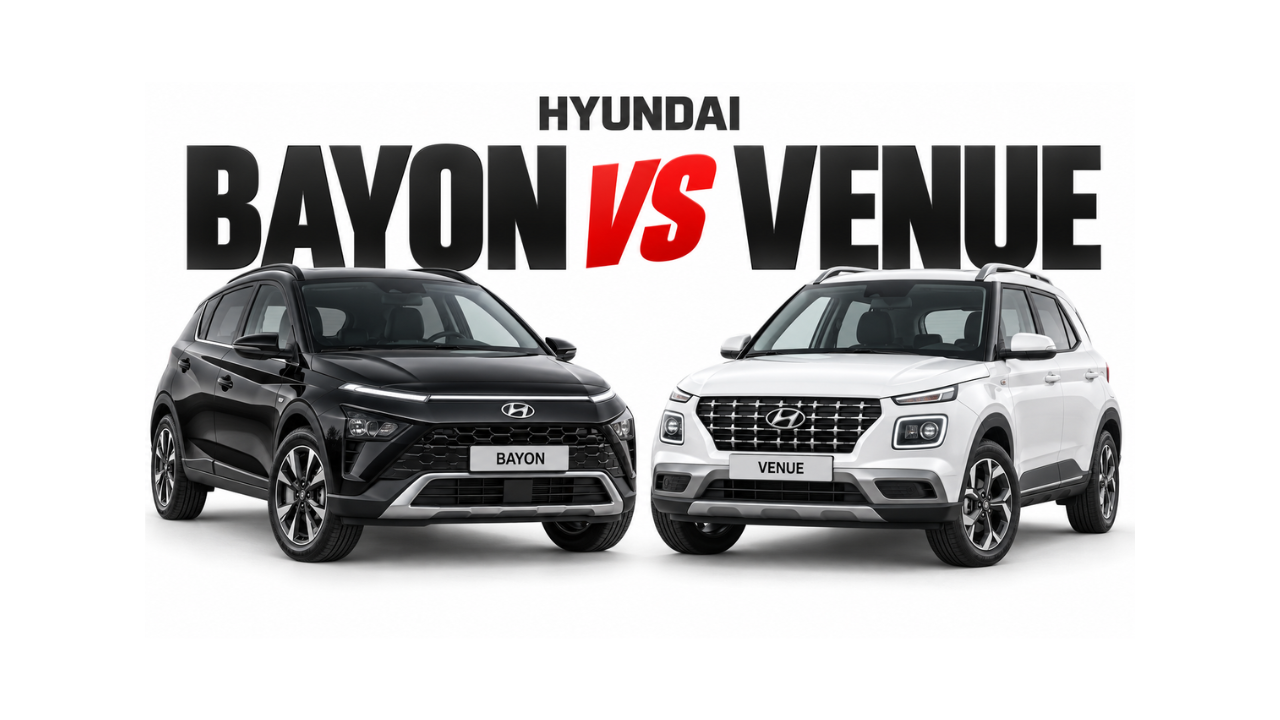
The Hyundai Venue is a sub-4-metre compact SUV already on sale in India at ₹8 lakh to ₹15.83 lakh (ex-showroom), with petrol, turbo-petrol and diesel engines and a 5-star Bharat NCAP rating. The Hyundai Bayon is an upcoming, larger (around 4.2 metre) SUV that Hyundai officially named on 14 September 2026. It is expected to launch in the 2026 festive season at roughly ₹9 lakh to ₹14 lakh, with a 1.5-litre petrol engine and a factory-fitted CNG option.
Hyundai Bayon vs Venue: Specifications Compared
| Parameter | Hyundai Venue (2026) | Hyundai Bayon (Expected) |
|---|---|---|
| Status | On sale | Launch expected Oct–Nov 2026 |
| Price (ex-showroom) | ₹8.00 – ₹15.83 lakh | ₹9 – ₹14 lakh (expected) |
| Segment | Sub-4m compact SUV | Compact / mid-size SUV (above 4m) |
| Length | 3,995 mm | Around 4,180–4,200 mm |
| Width | 1,800 mm | Not revealed |
| Height | 1,665 mm | Not revealed |
| Wheelbase | 2,520 mm | Not revealed |
| Ground clearance | 190 mm | Not revealed |
| Petrol engine | 1.2L NA petrol (83 PS) | 1.5L NA petrol (approx. 115 PS, 144 Nm) |
| Turbo petrol | 1.0L turbo (120 PS), MT / 7-speed DCT | Not expected at launch (reports vary) |
| Diesel | 1.5L diesel (116 PS), MT / AT | Not expected |
| CNG | Not offered | Factory-fitted CNG expected |
| Gearboxes | Manual, DCT, torque-converter AT | 6-speed manual, CVT (expected) |
| Safety rating | 5-star Bharat NCAP (March 2026) | Not tested yet |
| ADAS | Level 2 ADAS | Level 2 ADAS expected on top trims |
| Screens | Dual 12.3-inch displays | Dual 10.25-inch displays (expected) |
Venue figures are based on Hyundai India’s current line-up. Bayon figures are based on official teasers, spy shots and credible Indian auto media reports, and may change at launch.
Price: Bayon vs Venue
The Venue currently starts at around ₹8 lakh for the base HX2 1.2L petrol manual and goes up to ₹15.83 lakh for the top HX10 diesel automatic dual-tone. Hyundai has also added a Knight Edition and a more affordable HX8 diesel automatic variant during 2026.
The Bayon is widely expected to be priced between ₹9 lakh and ₹14 lakh. That means the two SUVs will overlap heavily in price. A top-spec Venue could cost as much as a mid or upper Bayon variant, so buyers will essentially be choosing between a smaller, fully loaded car and a bigger car with a simpler engine line-up.
Verdict on price: Too close to call until Hyundai announces official Bayon prices. Expect the Bayon’s base variant to start slightly above the Venue’s.
- Tata Aeris Tata Tigor Successor Sedan 2026
- Tata Aeris On-Road Price 2026 All Cities

- Facelifted Cars Launching in India Soon 2026

- Tata Aeris CNG Mileage 27km/kg

- Mahindra Vision S vs Thar Roxx 2026

Size and Practicality
This is the biggest difference between the two cars.
The Venue is deliberately kept under 4 metres (3,995 mm) to benefit from lower taxes in India. The new-generation Venue did grow taller and wider, with a longer wheelbase, which improved cabin space compared with the older model.
The Bayon is expected to be around 4.2 metres long, which places it in a larger class. That extra length should mean more rear legroom and a bigger boot. Hyundai’s decision to mount the CNG tank under the floor also matters, because most CNG cars in India lose a large part of their boot to the cylinder.
Verdict on space: The Bayon should win for families who regularly carry four or five adults or luggage. The Venue is easier to park and manoeuvre in tight city traffic.
Engine, Performance and Fuel Options
Hyundai Venue engines
The Venue gives you the widest choice in this comparison:
- 1.2L naturally aspirated petrol: Affordable and simple, best for city-only use.
- 1.0L turbo-petrol: Punchy performance, available with manual or a 7-speed DCT automatic. Best for enthusiasts and highway drivers.
- 1.5L diesel: Strong mid-range torque and good highway efficiency, available with manual and automatic. Best for high-mileage users.
Hyundai Bayon engines (expected)
The Bayon is expected to use the Creta’s proven 1.5-litre four-cylinder naturally aspirated petrol engine, making around 115 PS and 144 Nm, paired with a 6-speed manual or CVT automatic. The same engine is expected to get a factory CNG kit.
A few publications have mentioned a 1.0L turbo-petrol for the Bayon, but most reports point to the 1.5L NA petrol plus CNG. Wait for the official spec sheet before deciding on this basis.
Verdict on engines: The Venue is better for performance lovers and diesel buyers. The Bayon is expected to be better for buyers who want a smooth petrol automatic (CVT) or low running costs with CNG.
Features and Technology
Venue highlights
- Dual 12.3-inch curved screens (infotainment and digital cluster)
- Level 2 ADAS
- 360-degree camera
- LED lighting and 17-inch alloy wheels
- Dashcam on select variants
- Six airbags, ESC and TPMS
Bayon expected highlights
Hyundai has positioned the Bayon as an “intelligent SUV”, and the company’s leadership has said it will be more technology-heavy and built on a software-defined vehicle approach aimed at younger buyers. Based on teasers and spy shots, it is expected to get:
- Dual 10.25-inch screens with a cabin inspired by the next-generation i20
- Panoramic sunroof
- Ventilated and electrically adjustable front seats
- Automatic climate control (dual-zone reported on some trims)
- 360-degree camera and Level 2 ADAS on top trims
- H-Edge LED lighting, connected tail-lights and 17-inch alloy wheels
Verdict on features: Both will be well-equipped. The Venue has larger screens on paper; the Bayon is expected to add a panoramic sunroof and more premium comfort features.
Safety
The Venue has a 5-star Bharat NCAP rating (March 2026), which is a big plus for safety-conscious families. The Bayon has not been crash-tested yet. It is expected to get six airbags, ESC and Level 2 ADAS, but official safety ratings will only come after launch.
Verdict on safety: The Venue wins today because its rating is proven.
Design
The Venue has a boxy, upright SUV stance with bold front and rear styling, and a darker Knight Edition option.
The Bayon takes a more crossover-like approach. Spy shots and teasers show split headlamps, Verna-like lighting elements, a connected rear light bar, flared wheel arches, roof rails and body cladding. It should look noticeably larger and more premium than the Venue on the road.
Bayon vs Venue: Pros and Cons
Hyundai Venue
Pros
- Available now with immediate deliveries
- Three engine choices including diesel and turbo-petrol
- 5-star Bharat NCAP safety rating
- Compact size is ideal for city traffic
Cons
- No CNG option
- Tighter rear seat and boot than larger SUVs
- Top variants get expensive
Hyundai Bayon (Expected)
Pros
- Larger body with more space
- Factory CNG with underbody tank
- Premium features like panoramic sunroof and ventilated seats expected
- Smooth 1.5L petrol with CVT option
Cons
- Not launched yet; prices and specs unconfirmed
- No diesel expected
- No crash-test rating yet
- Likely slower than the Venue’s turbo-petrol
Which One Should You Buy?
| Your Priority | Better Choice |
|---|---|
| Need a car immediately | Venue |
| Diesel engine | Venue |
| Sporty turbo-petrol with DCT | Venue |
| Proven 5-star safety | Venue |
| Tight city parking | Venue |
| CNG with usable boot | Bayon |
| More rear seat and boot space | Bayon |
| Creta-like features on a smaller budget | Bayon |
| Smooth petrol automatic for family use | Bayon |
Our recommendation: If your purchase can wait until after Diwali 2026, it makes sense to see the Bayon’s official price and specifications before deciding. If you need a car now, or you want a diesel or turbo-petrol, the Venue is a safe and proven buy.
Frequently Asked Questions
Is the Hyundai Bayon bigger than the Venue?
Yes. The Bayon is expected to be around 4.2 metres long, while the Venue is 3,995 mm. The Bayon should offer more cabin and boot space.
When will the Hyundai Bayon launch in India?
Hyundai confirmed the Bayon name on 14 September 2026. The launch is expected in the 2026 festive season, around October–November 2026.
What is the expected price of the Hyundai Bayon?
The Bayon is expected to cost between ₹9 lakh and ₹14 lakh (ex-showroom). Official prices will be announced at launch.
Will the Hyundai Bayon come with CNG?
Yes, a factory-fitted CNG option is widely expected, with an underbody tank. It would be Hyundai’s first SUV over 4 metres with factory CNG.
Does the Hyundai Bayon have a diesel engine?
No diesel engine is expected. The Venue remains the option for diesel buyers.
Is the Indian Bayon the same as the European Bayon?
No. The European Bayon is an i20-based crossover. The India-spec Bayon is a new second-generation model developed for Indian customers.
Which is safer, Bayon or Venue?
The Venue has a 5-star Bharat NCAP rating. The Bayon has not been crash-tested yet, so the Venue is the proven safer choice for now.
Will the Bayon replace the Venue?
No. The Bayon will sit above the Venue and below the Creta. Both will be sold together.